
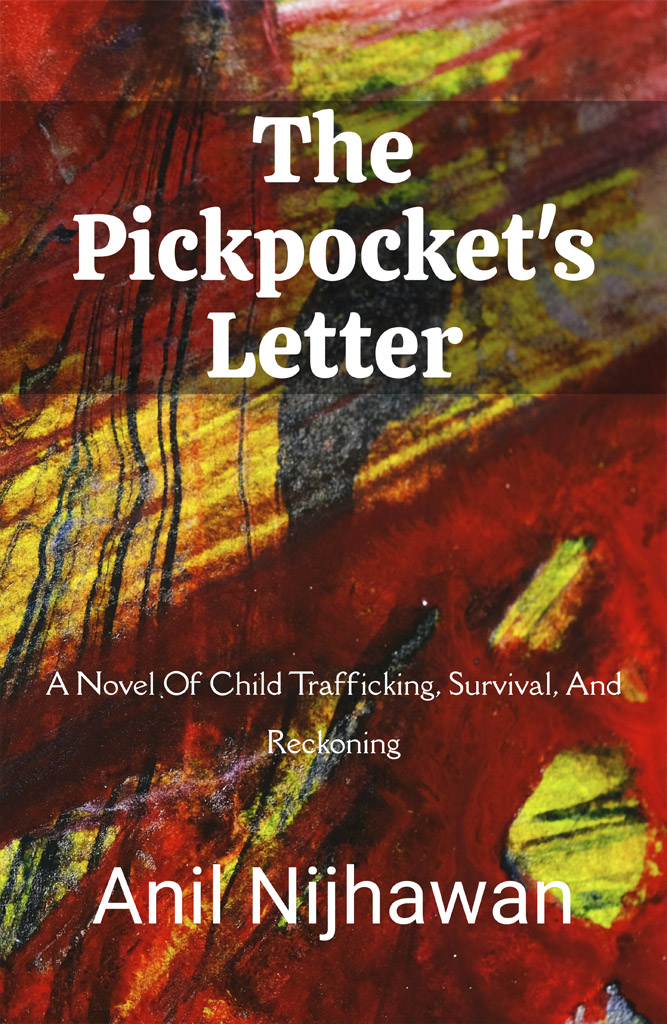
The story behind the story. Why did I write the novel, The Pickpocket’s Letter?
There are stories we read for entertainment—and then there are stories that quietly rearrange how we see the world. This literary crime novel set in India belongs firmly to the latter. It is a genre that transcends the mechanics of plot and suspense, offering a layered, immersive exploration of society, morality, and survival instead. At its core, such a novel is not simply about solving a crime. It is about understanding why that crime exists in the first place—and who is forced to live with its consequences.
The boy was about 13 or 14 years old. A mob was beating him mercilessly. They said he was a thief. It was not clear what he had stolen or from whom. I witnessed, shocked and trembling, the spectacle of vigilante justice from the window of our apartment. The boy at first protested his innocence and then appeared resigned. Like him, I was a teenager too, at the time, still in high school. The episode lasted no more than ten minutes, but its effect stayed with me for a long time. I began to wonder what had made the boy turn to thieving and what had made the mob turn to executioners without the input of a judge and jury. As I grew up, I began asking questions. What makes some people turn to crime? I realised it was a complex subject with no simple answers. According to psychologists and social scientists, the most important factors shaping us as we grow up are environment and culture. Where and how we grow up matters: family dynamics, socioeconomic conditions, education, culture, and even the historical moment. Growing up during instability can shape values, expectations, and identity. I researched several cases of underprivileged children in society. It led me to believe that the boy was from a broken home, without one or both parents, and that he was learning to survive as best he could.
Over the years, the seed for this novel began to germinate, its roots spreading far and deep. Seven years ago, I decided to take the plunge and write the story of one of these children. A fictitious story but rooted in the reality of modern-day India.
The Weight of Reality: A Story Rooted in Truth

A novel about child trafficking in India carries an inherent emotional gravity. This is not a fictional problem invented for dramatic tension; it is a reality that affects thousands of vulnerable lives. When woven into literature, the subject demands sensitivity, depth, and honesty. In these narratives, the crime is never abstract. It is deeply personal. We meet children who are more than victims—they are individuals with names, memories, and fragile hopes. We encounter families fractured by loss, investigators burdened by moral dilemmas, and communities caught between fear and silence. The story becomes an emotional crime story with social themes, one that refuses to let the reader remain detached. The emotional impact builds not just through shock, but through empathy. Every page asks: What would you do? What would you risk? And what does justice truly mean in a broken system?
Beyond Crime: A Literary Examination of Class and Power
What distinguishes this genre from conventional thrillers is its literary ambition. A literary fiction about class and injustice doesn’t rush toward resolution—it lingers in the uncomfortable spaces. India’s social landscape, marked by deep economic divides and layered hierarchies, provides fertile ground for such exploration. In these novels:
-
Wealth can insulate wrongdoing
-
Poverty can erase visibility
-
Power can distort justice
Characters are shaped by these forces. A police officer may be constrained by bureaucracy or corruption. A journalist may struggle between truth and safety. A survivor may find that escaping physical danger is only the beginning of a much longer journey. The narrative voice often reflects this complexity—lyrical yet unflinching, intimate yet expansive. It invites readers not just to witness injustice, but to understand its roots.
Kolkata: The Pulse of the Story
Few cities can embody contradiction as vividly as Kolkata, making it an unforgettable setting for a survival story set in Kolkata. Once the cultural capital of India, the city pulses with art, literature, and history. Yet beneath its intellectual vibrancy lies a harsher reality. The streets tell multiple stories at once:
-
Tram lines and colonial architecture echo the past
-
Crowded markets and alleyways hum with present-day urgency
-
Hidden corners conceal networks that thrive in silence
In this environment, survival is not just physical—it is emotional and psychological. Characters must navigate a world where danger can be both visible and invisible. Kolkata, in these novels, is not merely a backdrop. It is a living, breathing presence—one that shapes every decision, every risk, and every moment of hope.
The Human Spirit: Resilience in the Face of Darkness
Despite the heavy themes, these stories are not devoid of light. In fact, what makes them unforgettable is their ability to find hope without diminishing reality. A crime novel with a hopeful ending does not promise easy solutions—but it offers something more meaningful: the possibility of change. Hope emerges in quiet, powerful ways:
-
A survivor reclaiming agency
-
An ally choosing courage over complicity
-
A system, however flawed, is being challenged
-
A truth that refuses to remain buried


0 Comments